Forty-five minutes
before you load it.
The tissue has to be under load for any of this to matter, and the dose goes in 30 to 60 minutes before the session, with vitamin C. The timing is the part the category leaves out.
15 G AT T–45 · TRAINING DAYS
The panel specifies 9 g of protein in a 10 g serving; the lab measured 9.8 g. All three certificates, figure by figure ↗
30 days · one email · full refund
Collagen peptides, Type I and III. One ingredient. Lead at 0.07 mcg against a Prop 65 limit of 0.5, on lot 121125450 — including the certificate that comes out worst for us: that one was run by the company that makes the powder, and the other two were not. Tare (v.) — to zero the scale before an honest measurement.
- 3 CERTIFICATESPUBLISHEDWHOLE
- LOT-NAMEDCERTIFICATEONE OF THREE
- POTENCYMEASURED ONTWO OF THREE
- LOT-NUMBEREDALL THREE
- 30-DAYGUARANTEEONE EMAILFULL REFUND
Under Load, at a glance
- Bovine collagen peptides, Type I & III
- One ingredient · net 350 g
- Label serving 10 g · two scoops · 35 servings
- The protocol: 15 g · three scoops · 23 uses a tub
- 30–60 minutes before training · training days only
- With 50–100 mg vitamin C — not in the jar
- Protein measured at 9.8 g against a 9 g specification
- Lead at 0.07 mcg against a Prop 65 limit of 0.5
- The certificate names its lot
- It was run by the company that makes it
Forty-five minutes
before the first
working set.
Collagen is a substrate, not a stimulus. In the work this protocol is built on, collagen taken without loading did essentially nothing — the tissue has to be under work for any of it to matter. So the dose is not a scoop in the morning. It is 15 g, three scoops, 30 to 60 minutes before the session, with 50 to 100 mg of vitamin C, on the days you train. The vitamin C is not in the jar; it is an orange, or a tablet from anywhere. That is the entire protocol, and the timing is the part the category leaves out.
Collagen is not a beauty supplement that men can also take. It is a connective-tissue supplement that got sold to women. The ingredient is not unfamiliar to you. The protocol is, and the protocol is the part that does the work.
Train four or five days a week for long enough and the thing that gives first is rarely the muscle. It is the elbow, the patellar tendon, the joint that was fine in March and is not fine in May. The cost of that is not a tub of anything. It is six weeks of a block you do not get back. TARE exists for the men who count the weeks they lose. We are not going to tell you a powder prevents that — nothing in this literature earns that sentence, and the paragraph four down says so with the trials named.
The ranking, before you ask for it. Of the three things TARE sells, this is the one whose paperwork has the softest edge — and it is not the potency. Under Load's certificate reports a measured result: 9.8 g of protein against a 9 g specification. Base Work's reports 99.87% creatine monohydrate against a specification of more than 99.5%. Both are results rather than limits. The difference is who ran them. Creatine and Night Work were tested by an independent lab that had nothing to do with making them. The collagen was tested by the company that makes it. That's a weaker check, and you should hear it from us rather than work it out later. If you are buying one jar this month on documents alone, buy the creatine.
What it did find, on lot 121125450: protein at 9.8 g against a 9 g specification, by ISO 14891. Lead at 0.07 mcg against a Prop 65 limit of 0.5. Mercury, arsenic and cadmium below the detectable limit. Total plate count, E. coli, salmonella, yeast and mould, all pass. Measured results, not specification limits — all of them on one page, with the lot they were run on.
Run that forward. The panel specifies 9 g of protein in a 10 g serving; the lab measured 9.8 g. The protocol's 15 g is one and a half of those servings, so the specification scales to 13.5 g and the measured figure to 14.7 g — 1.5 × the two numbers above, arithmetic rather than a second test. We print what we were promised beside what was measured, in that order, and the measured one is the larger. That is the only direction that arithmetic is allowed to go on this site.
Three fair criticisms, in our own words, before you find them somewhere else. One: it is a poor protein. No tryptophan, very little leucine, a DIAAS effectively at zero. This is not a protein supplement and we do not sell it as one — do not count that 14.7 g against your day. Two: it is hydrolysed gelatin. Largely true. The difference is molecular weight and where the chains were cut, not the source, and anyone telling you it is a different substance is overselling. Three: the skin evidence is weak. Am J Medicine, 2025 — review of 23 randomised trials, n=1,474: the independently funded ones showed no effect. We make no skin claims, and the reason we are not making them is worth more than the claim was.
The evidence, at its actual size. Am J Clin Nutr, 2017 — 5 g against 15 g of gelatin with vitamin C, one hour before loading, n=8 healthy men: 15 g roughly doubled serum PINP, a marker of collagen synthesis, and 5 g landed in between. Eight men, and a marker in blood rather than a tendon. Downstream, JFMK, 2026 — systematic review: tendon cross-sectional area and stiffness increased at 15 to 30 g a day, with loading. Against it: that same review grades the evidence strong — GRADE A — against an effect on muscle strength, and the 2024 Sports Medicine meta-analysis that did find an effect measured it at SMD 0.19 — trivially small, and low-certainty by its authors' own rating; 30 g bought nothing over 15 g; and MSSE, 2023 found no increase in muscle connective protein synthesis from 30 g after exercise, which is why we say collagen is not a muscle-building protein. No randomised trial shows a reduced injury rate. If a jar implies one to you, it is selling from a study that does not exist.
Lot Mark 3 / 4. Four questions a certificate can answer, counted: on lot 121125450 potency, metals and microbiology carry a measured result, and identity does not. The panel says collagen peptides and no assay on this document confirms that it is. The missing quarter is on the face of the mark rather than off the bottom of it. The four states, the margins, and the arithmetic underneath them.
Collagen peptides support connective tissue.*
*This statement has not been evaluated by the Food and Drug Administration. This product is not intended to diagnose, treat, cure, or prevent any disease.
Recovery is a system.
Three jars on a clock, not three promises. What follows is the whole of what TARE says these do: one sentence, on the collagen, asterisked, printed above with its disclaimer. There is no second.
One ingredient, and a time of day
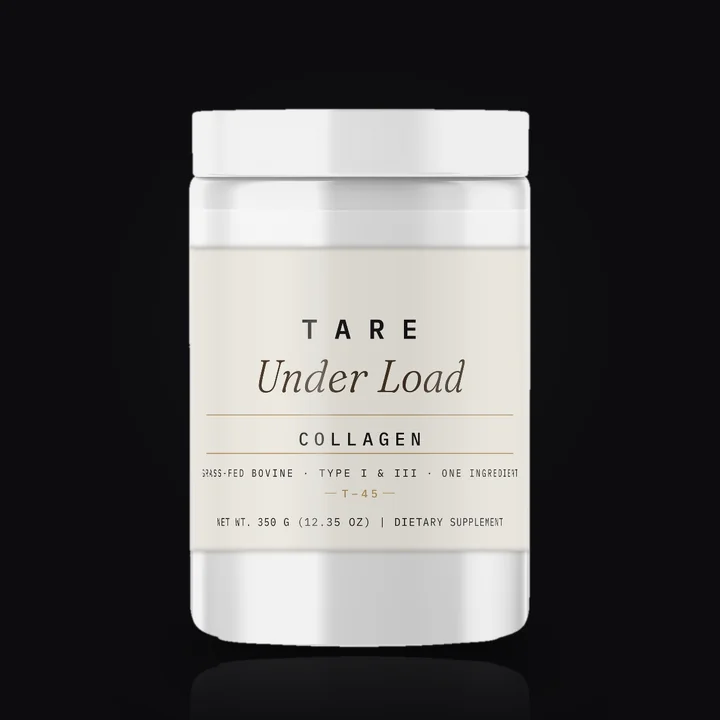
Bovine collagen peptides, Type I and III, and nothing else in the tub. 15 g, three scoops, 30 to 60 minutes before the session, with vitamin C, on the days you train. The tissue does the work. The powder is only what it has to work with.
The best-documented thing we sell
5 g of creatine monohydrate, assayed at 99.87% against a specification of more than 99.5%, by a laboratory that had nothing to do with making it. It is the strongest document in the range, and it is not the jar this page is built around. We would rather you knew that.
What we took off, and why
No injury claim. No strength claim. No skin claim. Nothing in this literature earns any of the three, and the paragraphs above name the trials that fail to earn them. Two jars were retired this year for the same reason — what came off, and what came off with it.
Dose like you train.
The tissue has to be loaded
The work this protocol comes from fed the dose 30 to 60 minutes before loading, not after it, and collagen taken without loading did essentially nothing. That is the whole reason there is a clock on the jar. A scoop on a rest day has no mechanism behind it in the literature we are citing, and we would rather say so than sell you thirty-five servings you were going to use in twenty.
Two numbers that disagree, and why
The printed panel says 10 g and 35 servings. This site says 15 g and 23 uses. Both are true: the panel states what a serving of the powder is, and the protocol states the dose the tendon literature actually used. We are not allowed to print the protocol on the label and we would not want to — a jar should say what is in it. Collagen isn't caffeine either. There is no honest way to tell you what week two feels like: judge it on the count, and if you get to the end of a tub with nothing to show for it, that is what the guarantee is for.
Run it on your own shelf first
Everything above works on any jar. Pick up whatever you already take. Find the serving size. Find the figure that is the compound and the figure that is the element. Then see whether the front of the bottle prints the second one. A minute, nothing spent — and if it sends you back to the tub you already own, the minute still paid. Then run it on ours: three panels in The Monograph, three certificates on one page.
Two figures.
One of them is the mineral.
The arithmetic this brand is named after, run on our own jar. Night Work's panel prints both figures. A front label prints one.
-
2,500 mg
Magnesium glycinate — the compound. The whole molecule on the scale, glycine and all. It is the larger of the two figures and it is a true one.
-
0
Tare (v.) — to zero the scale before an honest measurement. The brand is named after this step. Everything after it is a measurement of what is actually there.
-
2,500 mg
− 2,225 mg
Glycine and what it comes with — the part that is not magnesium. It is doing a real job and it is most of the weight. It is just not the mineral.
-
275 mg
Elemental magnesium · 65% DV — about nine times less than the compound weight, never ten. This is the figure the arithmetic was for.
-
A front that prints the compound
MAGNESIUM GLYCINATE
2,500 MG
A front that prints the element
MAGNESIUM
275 MG
Both figures are true and both are on our panel. Which one a front prints is a choice — often enough the larger one that the arithmetic is worth running yourself.
-
2,500 mg − 2,225 mg = 275 mg
Now run it on the jar you already own. Pick up whatever you already take. Find the serving size. Find the figure that is the compound and the figure that is the element. Then see whether the front of the bottle prints the second one.
A minute, nothing spent — and if it sends you back to the tub you already own, the minute still paid. Then run it on ours: three panels in The Monograph, three certificates on one page.
Three moves.
Zero guesswork.
Three jars on one clock — 45 minutes before the session, daily, and at night. Each piece has one job, in order.
Under Load

9.8 g of protein measured, against a 9 g specification
Lot Mark 3 / 4 · lot 121125450
One ingredient: bovine collagen peptides, Type I & III. 15 g, three scoops, 30 to 60 minutes before the session, with 50–100 mg of vitamin C. Training days only — the tissue has to be loaded for any of it to matter.
Base Work

99.87% creatine monohydrate, against a specification of more than 99.5%
Lot Mark 4 / 4 · lot CM20251225A
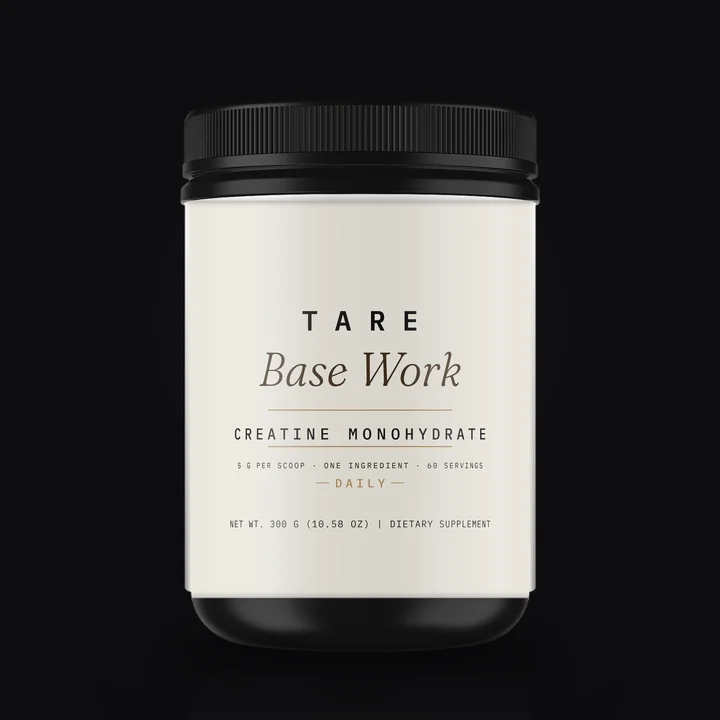
5 g, any time of day, on every day. One ingredient and no flavouring. The assay was run by a laboratory that had nothing to do with making it, which is why this is the strongest document we hold. Not shipped to New York — New York law requires a delivery method we can't offer.
Night Work

275 mg elemental magnesium claimed · no measured figure exists — the certificate carries no potency test
Lot Mark 1 / 4 · raw-material lot MGL260212
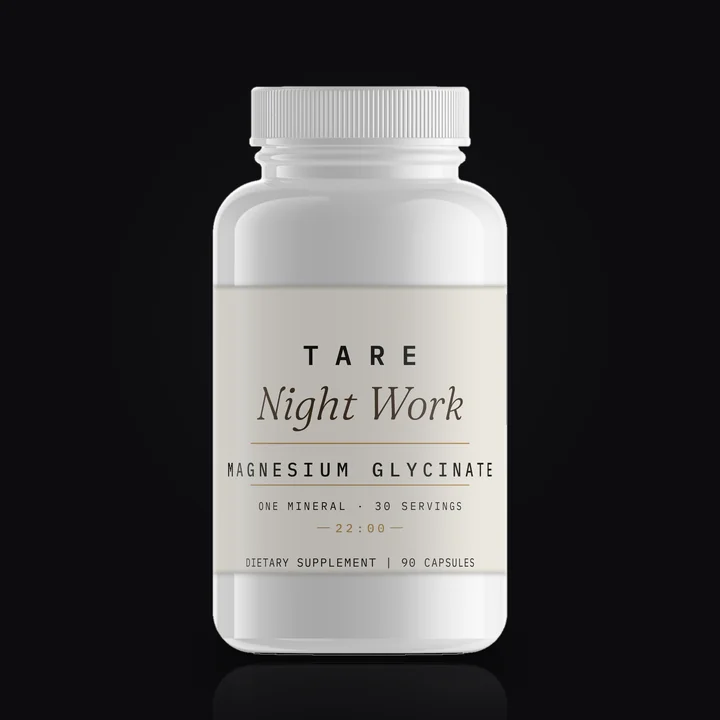
2,500 mg of magnesium glycinate. Then 275 mg — the elemental magnesium it actually carries, 65% of the daily value, and the only one of the two that belongs on a front panel. One form. No melatonin, no blend. Three capsules.
One number before you run all three — the day's supplemental magnesium against its published ceiling — is set out with its arithmetic on The Monograph. It used to be two numbers, and the second belonged to a jar that no longer exists.
You don't have to start with three. Bought one at a time they come to $192; all three together are $169, and the pairs sit between. The ladder is below with its arithmetic printed beside it — every rung is a discount off the three numbers above, and there is nothing else in it.
Measured.
Not marketed.
Every number on our label is printed here with the document behind it. Three certificates, every figure with its lot number, on one page. Two of the three report a measured result against a specification; the magnesium document reports microbiology only, and the page says so. That is new, and it is the reason two products are not on this page any more. What differs between them is who ran them: two by a laboratory that had nothing to do with making the product, one by the company that makes it. Then go and ask the other jar on your shelf for theirs.
One precision. All three documents are published whole, reproduced on the testing page as images. Our manufacturer gave that permission in writing on 17 August 2026, having first advised against it. Every figure this site argues from is transcribed beside them, so you can check our reading against the document rather than take it. See all three.
The three certificates, transcribed
Under Load — collagen peptides · $79
Base Work — creatine monohydrate · $54
The full ledger
Buy Base Work — $54 Not sold to New York
Night Work — magnesium glycinate · $59
The full ledger
Running all three — the number we’d rather you got from us
The long version
Where the 350 mg ceiling comes from
The 350 mg ceiling is the tolerable upper intake level for supplemental magnesium in adults, set by the US National Academies' Dietary Reference Intakes. It is a ceiling on what you take in a capsule, not on what you eat. Night Work puts 275 mg against it and nothing else we sell puts anything, so the day has 75 mg of headroom — which a greens powder or a second electrolyte can spend without asking you first. The arithmetic is in the table on The Monograph above. If that is tight for you, buy the pieces you want instead of the system.
What the collagen evidence covers, and where it stops
The tendon work is real, it is young, and it is smaller than the category implies. The trial the timing comes from ran eight men and measured a marker in blood, not a tendon. The systematic review downstream of it found cross-sectional area and stiffness rising at 15 to 30 g a day with loading. Against that: the same review grades the evidence strong — GRADE A — against an effect on muscle strength, and the 2024 Sports Medicine meta-analysis that did find an effect measured it at SMD 0.19 — trivially small, and low-certainty by its authors' own rating; 30 g bought nothing over 15 g, and 30 g after exercise produced no increase in muscle connective protein synthesis at all — which is why we say plainly that collagen is not a muscle-building protein. No randomised trial shows a reduced injury rate. The journals, years, designs and sample sizes are printed in section 01 above rather than gestured at down here.
What we do not hold, and what we have instead
We hold no third-party product certification. Not NSF Certified for Sport, not Informed Sport, not USP. Those cost between eight and eighty thousand dollars a year and they are out of reach this year, and we would rather write that sentence than let a badge imply otherwise.
There are three different things all called tested, and the category lets you confuse them. One: the building was inspected. That is what a facility GMP mark is, and it tells you nothing about your tub. Two: a product was tested once — usually a representative sample, often years old, sometimes with the laboratory's name removed. Three: this lot was tested, on a certificate that names the batch. Almost every badge in this category is the first or the second. We publish the third, and until our manufacturer's own facility letters are in our hands there is no facility badge on this site at all — the ones that used to be here belonged to a supplier we no longer use, and they came down the day we left. The long version opens the testing page.
What a lot number does and does not cover
One note on the certificates. Each names the lot it was run on — 121125450 for the collagen, CM20251225A for the creatine, and MGL260212 for the magnesium — which is the difference between a certificate and a brochure. It is not your lot: nothing connects the jar we ship you to the lot on the document, and we never touch the production line. That sentence gets deleted the day it stops being true and not one day sooner.
Two jars that came off the range, and why
The hardest paragraph on this page, and it is not an apology. We changed manufacturer this year and audited what the new one could actually document. Two products did not survive it. The colostrum went because no immunoglobulin assay exists on any lot from either supplier, so the number a buyer most wanted to check was the one number we could not show him. The shilajit went because there is no certificate for it at all. The electrolyte jar went as it was constituted — its creatine half survives as Base Work, and the electrolyte load is gone until there is a certified formula to put in it. Four jars became three, the range got shorter, and two of the three report a measured result. Each one, with the figure that killed it, is on the testing page.
I got tired of choosing between brands that shout and brands that glow. I train. I wanted one jar with a real number on it — protein at 9.8 g against a 9 g specification — and the certificate where I could read it. This year I changed manufacturer, audited what the new one could actually document, and two of the four jars did not survive it. What is left is three, and the one this page is built around has the softest paperwork of the three because the company that makes it ran its own test. Better coming from me.
No mascots. No miracle words. A scale, zeroed, before every number on this page.
— D., founder
30 days. One email. Full refund.
No forms, no phone calls, no retention script, no "return the empty jar" games. Cancel is a button — one step, any time. Once per product per customer: a guarantee, not a rolling discount.
Two ways in.
Climbing always pays.
Three jars, bought one at a time, come to $192. Every rung below is a discount off those three printed numbers — never a struck-through price that never existed. All three together are $169, the pair is $119, and the amount each one takes off is printed beside it so you can check it against the three.
The Standard
$132 every 30 days once Batch 001 ships, until you cancel. Same price in month twelve as in month one — no intro rate, no step-up. Pause, skip, change the date, change the card, or stop it, all from your account. Nothing is charged today — the plan opens when Batch 001 ships. The jars are on sale now as one-time orders.
- All three, on the clock. One shipment, one month of each.
- Under Load $79 + Base Work $54 + Night Work $59 — the three prices are printed below, and this rung is $23 off them.
- Three certificates, every figure it argues from transcribed with its lot number — two of the three report a measured result, and each panel names the laboratory that ran it
- 275 mg of supplemental magnesium a day against a 350 mg ceiling — the arithmetic is on The Monograph, and it is the only stacking number this range still has
- Shipping is $7.95, flat, on this order and every other — the threshold rule this page carried for a year came off our previous fulfiller's rate card and left with them, and there is no spend line to clear in its place
- Doesn't ship to New York — it contains Base Work, and New York law requires a delivery method we can't offer. The creatine-free pair below is the only bundle that goes there
Tick the box above to continue
Subscriptions open when Batch 001 ships · nothing is charged today
The Standard Guarantee — 30 days · one email · done
The Two
$93 every 30 days once Batch 001 ships, until you cancel. Same price in month twelve as in month one — no intro rate, no step-up. Pause, skip, change the date, change the card, or stop it, all from your account. Nothing is charged today — the plan opens when Batch 001 ships. The jars are on sale now as one-time orders.
- Under Load — collagen peptides before training, with protein measured at 9.8 g against a 9 g specification
- Base Work — 5 g of creatine monohydrate, assayed at 99.87% against a specification of more than 99.5%
- $79 + $54 — both prices are on this page, and this pair is $14 off them
- No magnesium in either jar, so this pair spends none of the 350 mg daily ceiling — The Monograph carries that arithmetic for the rung that does
- Shipping is $7.95, flat, with no spend line to clear
- Doesn't ship to New York — it contains Base Work. The creatine-free swap below is the only bundle that can
Tick the box above to continue
Subscriptions open when Batch 001 ships · nothing is charged today
The Standard Guarantee — 30 days · one email · done
The long version
Single jars, and what each costs
Or just one jar. Under Load $79 once. Base Work $54 once. Night Work $59 once. Each of those links goes to that jar's own page on the store; bought there it is a one-time order and nothing renews. A single-jar plan starts on that jar's own page, beside its billing terms. A link inside a sentence is the wrong place to begin a recurring charge. The three come to $192 together, and that is the number every rung above is a discount off — the range changed manufacturer this year, so none of these is an old price carried forward. Shipping is $7.95 flat on each of them.
The creatine-free swap, priced
Already buy creatine? Then you own the cheapest part of this system — monohydrate is a commodity and our tub is not special, it is only well documented. Swap Base Work for Night Work and The Two, Without Creatine is $124. It is the dearer pair, because the magnesium is the dearer jar: $79 + $59 is $138, and this takes $14 off it — the same $14 the creatine pair takes off its own two.
New York: what ships and what does not
And it's the only bundle that ships to New York. §391-oo needs a signature-and-photo-ID delivery for creatine that our shipping partner doesn't offer, so nothing containing Base Work goes there — not The Two, not the full protocol. The collagen-and-magnesium pair has no creatine, so it does. In New York you can buy that pair, and Under Load or Night Work on their own. Not Base Work itself — it is the jar the statute is about — and not the three.
Shipping, and what it costs
$7.95, flat, on every order. One jar or three, bought once or subscribed, and there is no spend line to clear — the threshold rule this page carried for a year was the first weight tier on our previous fulfiller's published rate card, and it left when they did. Our new one bills carrier cost by dimensional weight, so the true figure moves with the box: $7.95 runs under it on the collagen and over it on the magnesium. That is what a flat rate is, and we would rather print one number you can check than a table you have to work out. Also settled: orders leave 1–2 business days after they are placed, with a 2pm EST cut-off, and domestic delivery runs 5–9 business days by USPS and 5–7 by UPS, end to end. International is 12–16. Those windows are at checkout and in the shipping policy as well as here.
Why Subscribe & Save is pre-selected
One thing about the pre-selection. Subscribe & Save is ticked on load, because it is the cheaper of the two. The box that says you agree to be billed again is not ticked — that one's yours. The rates, each measured against the same order bought once with shipping counted on both sides: Under Load 19.6%, Base Work 19.4%, Night Work 19.4%, The Two 20.5%, all three 20.9%. Un-averaged, one rung at a time, so you can check any of them against the two prices printed beside it — add the $7.95 to both sides first, which is what these rates are measured on. Same price in month twelve as in month one — no intro rate and no step-up. The plans open the day Batch 001 ships; until then every jar and every rung is sold once, at the printed price.
Batch 001 is counted.
First production run. The count is a fact about manufacturing — no countdown, no timer, nothing here expiring while you read it. The jars are priced above; this form is for the subscription, which opens the day Batch 001 ships. An email, no card, nothing charged. Every figure this site argues from is already up, so there's something to hold us to first.
No spam. Exactly two emails: one when your jar is ready, one when the certificate publishes. Then the list ends.
Asked. Answered.
Why collagen, and why 45 minutes before?
Because collagen is a substrate, not a stimulus. In the work this protocol comes from, collagen taken without loading did essentially nothing — the tissue has to be under work for any of it to matter, and the dose went in 30 to 60 minutes before the session, with vitamin C. Pre-, not post-. That is the whole protocol, and the timing is the part the category leaves out.
The evidence and its limits — journal, year, design and sample size for each — are printed in section 01 rather than gestured at.
How do I take it?
15 g — three 5 g scoops — in water or a shake, 30 to 60 minutes before you train, with 50 to 100 mg of vitamin C. The vitamin C is not in the jar; it is an orange, or a tablet from anywhere. Training days only: a scoop on a rest day has no mechanism behind it in the literature we are citing, and we would rather say so than sell you servings you were never going to use.
Base Work is 5 g of creatine, any time, every day. Night Work is three capsules at night.
Why does the label say 10 g and the site say 15 g?
Because they answer different questions. The Supplement Facts panel states what a serving of the powder is — 10 g, two 5 g scoops, 35 servings — and it is locked. The site states the dose the tendon literature actually used, which is 15 g, three scoops, and works out at 23 uses a tub. We are not allowed to print the protocol on the label and we would not want to: a jar should say what is in it, not how we think you should use it. Both figures sit next to each other on The Monograph.
Isn't collagen a beauty supplement?
The marketing got female-coded; the molecule didn't. Collagen is not a beauty supplement that men can also take — it is a connective-tissue supplement that got sold to women.
We make no skin claims at all. Am J Medicine, 2025 — a review of 23 randomised trials, n=1,474 — found that the independently funded ones showed no effect on hydration, elasticity or wrinkles. The reason we are not making that claim is worth more to us than the claim was.
Isn't this just hydrolysed gelatin?
Largely, yes, and it is a fair thing to ask rather than a gotcha. The difference is molecular weight and where the chains were cut, not the source, and anyone telling you it is a different substance is overselling. What we sell is one ingredient, a measured protein figure, and a time of day — not a proprietary process.
Doesn't collagen have a DIAAS of effectively zero?
It does. No tryptophan, very little leucine — as a protein it is poor, and that is the second of the three criticisms we print against ourselves. This is not a protein supplement and we do not sell it as one: do not count the 14.7 g against your day. It is a substrate for connective tissue at a specific time, and it is dosed as that.
Why did two of your products disappear?
We changed manufacturer this year and audited what the new one could actually document. Two jars did not survive it. The colostrum went because no immunoglobulin assay exists on any lot from either supplier — the one number a buyer most wanted to check was the one we could not show him. The shilajit went because there is no certificate for it at all. The electrolyte jar went as it was constituted; its creatine half survives as Base Work, and the electrolyte load is gone until there is a certified formula to put in it.
Four jars became three, and two of the three we still hold report a measured result. Each one, with the figure that killed it, is on the testing page.
Who actually ran the tests?
Three certificates, and the question worth asking is not who ran them but what each one covers. One names the lot our own tub was filled from — the collagen, lot 121125450 — and the laboratory that ran it belongs to the company that manufactures the powder. That is a weaker check than an outside lab, and you should hear it from us rather than work it out later.
The creatine’s certificate does come from an independent laboratory. Read whose sample it is, though: it was issued to the ingredient supplier against a sealed bag of raw material, with the serving size recorded as N/A. It certifies the powder before it became our product, not the tub on your shelf. The magnesium document came from that same laboratory, and it covers a raw-material powder lot tested for microbiology only — it carries no identity, potency or heavy-metal result, so it cannot vouch for what is in the capsule.
So: one of three names a lot we filled, and none of the three is an outside laboratory testing a finished TARE tub. Getting one is the next thing on this list, and it will appear here when it exists.
Two of the three report a measured result against a specification, which is new this year: the collagen assays protein at 9.8 g against a 9 g specification, and the creatine at 99.87% against a specification of more than 99.5%. Every figure, with the laboratory and the lot beside it, is on one page.
We hold no third-party product certification — not NSF Certified for Sport, not Informed Sport, not USP. They cost between eight and eighty thousand dollars a year and are out of reach this year. We would rather write that sentence than let a badge imply otherwise.
Where is it made?
By Rocktomic Labs, LLC, in Lawrenceville, Georgia.
There is no facility badge anywhere on this site and there will not be one until their own certification letters are in our hands. The badges that used to be here belonged to a supplier we no longer use, and they came down the day we left. A facility mark certifies that a building was inspected — it tells you nothing about the powder in your tub, which is the distinction the testing page opens with.
What results should I expect?
One sentence, asterisked, and it is the whole ledger: collagen peptides support connective tissue.* There is no second one coming.
What we will not tell you: no randomised trial shows a reduced injury rate, the 2026 JFMK systematic review grades the evidence strong — GRADE A — against an effect on muscle strength, and 30 g taken after exercise produced no increase in muscle connective protein synthesis. No supplement replaces training, food, or rest. Judge it on the count — three scoops, before the session, on the days you train — and if you get to the end of a tub with nothing to show for it, use the guarantee.
Anything I should know before running all three?
One number. The full protocol puts 275 mg of supplemental magnesium into your day, against a published tolerable upper intake level of 350 mg from supplements. That leaves 75 mg, which a greens powder or a second electrolyte can spend without asking you first. Nothing else in the range carries any magnesium at all: the jar that used to add more is retired, so this is one number now rather than two.
Night Work's certificate carries no potency section at all, so there is no measured magnesium figure to publish and none will be. The 275 mg above is the label figure, and this arithmetic runs on it. That absence is what the Lot Mark of one of four records.
What does it cost?
Under Load is $79, Base Work $54, Night Work $59. Bought one at a time the three come to $192. The old prices were set against four jars from a supplier we no longer use, so they went with the jars.
The single jars are printed first and every rung is a discount off those three printed numbers: The Two is $119, the creatine-free pair $124, and all three together $169 — $23 off buying them separately. Never a struck-through price that never existed, no coupon code, and no countdown. Shipping is $7.95 flat, with no spend line to clear.
Subscription terms?
Subscribe & Save takes Under Load to $62, Base Work to $42, Night Work to $46, The Two to $93 and all three to $132. Against the same order bought once, with shipping counted in both, that is 19.4% off on the smallest rung and 20.9% off on the largest, and the rate for each rung is printed beside it. The plans open the day Batch 001 ships; until then the jars are sold once, at the printed price.
Two ways to cancel: the button in your account, or one email to support@taketare.com. Not a phone call, not a form, not a retention script, and no "email us within a window." A self-service portal goes live the day Batch 001 ships — cancel, pause, skip, change date or payment, one step.
The subscription option is pre-selected, because it is the cheaper of the two. The box that says you agree to be billed again is not pre-ticked. Two different things, and we are not going to blur them. Same price in month twelve as in month one — no intro rate, no step-up, no free trial that turns into a charge.
What's the guarantee?
30 days from delivery. If TARE is not part of your training week, one email gets you a full refund. No forms, no phone calls, no "return the empty jar" games. Once per product per customer — a guarantee, not a rolling discount.
Shipping?
Orders leave our fulfiller 1–2 business days after they are placed, with a 2pm EST cut-off. Domestic delivery runs 5–9 business days end to end by USPS and 5–7 by UPS. International is 12–16.
What it costs is $7.95, flat, on every order — one jar or three, bought once or subscribed, with no spend line to clear. The old rule charged a flat rate under a threshold and nothing over it; it was the first weight tier on our previous fulfiller's rate card and it left with them. One figure across the range runs under our carrier cost on the collagen and over it on the magnesium, which is what flat means, and we would rather print one number you can check than a table you have to work out.
One product-specific exclusion: Base Work — and The Two and The Standard, which both contain it — does not ship to New York. New York General Business Law §391-oo makes creatine-containing supplements an 18+ product and requires an adult to sign for the box and show photo ID at the door; our shipping partner sends standard parcel and does not offer that. Under Load and Night Work ship to New York normally, and so does the creatine-free pair. Full wording on the policies page.